Showing posts with label Epiphany 3. Show all posts

Saturday, 21 January 2023

Epiphany 3, January 22nd 2023.


Rise within us like the star 

And make us restless

Till we journey on

To seek our peace in you


Song “Will you come and follow me” https://youtu.be/o469PRLdbHU


Reflection on Matthew 4v12-23


Having heard of John the Baptist's arrest, Jesus leaves the wilderness of Judea and heads for Galilee, making the centre of his operations Capernaum, a Gentile area, rather than Nazareth where he grew up. 


Matthew does not record Jesus' early Judean ministry which, from his baptism till his move to Galilee, which probably lasted about a year. John's arrest triggers a retreat. Jesus takes up John the Baptist's preaching ministry, proclaiming the coming of the kingdom. 


John's arrest prompts Jesus to change his ministry style. With Capernaum as the base of his operations, Jesus now takes on the role of an itinerant preacher and healer. The time lag between Jesus' temptation and the commencement of his ministry in Galilee could well be around one year


Jesus could be confused as one of John's disciples, although Galilee, as is Perea where John was arrested, is in the territory ruled by Herod Antipas.

  
Capernaum is a large, significant town, with a large Gentile population.

It is by the lake Galilee and inhabited by the tribes of Zebulun and Naphtali.

It is from this devastated and unwanted place that Jesus begins his ministry in earnest. In Isaiah, the invading Assyrians may overwhelm the land occupied by the northern tribes of Israel, but out of this darkness a light will one day shine. Isaiah's prophecy of a light to the Gentiles is fulfilled in Christ's move to Capernaum. Jesus comes preaching the coming kingdom, Jesus like John calls for repentance and a reliance on God.

Foreigners from the north east heading through Israel to the Mediterranean (as with the Assyrians' invasion that Isaiah consistently predicted) came across the Jordan, through Galilee, on the way to the Mediteranean sea. Jews only made up some 50% of the population of Galilee. For those living in a deadly shadow, a light has dawned. (How much do we need this!)

  
The people of Israel often understood the kingdom in terms of the restoration of the Jewish state, the prophets described something more than a new Davidic empire. God will call together a people who will gather in the presence of the living God and dwell securely under Gods reign. 


Jesus tells people to repent, to turn around. a radical change of heart and mind. 

  
Lake Galilee (21km. by 11km.) had a prosperous fishing industry. Simon and Andrew were from Bethsaida and probably came to the area for employment. They had probably had heard Jesus speak on a number of occasions and were now called by him. Jesus said follow me, be disciples, go with Jesus, learn from him. These fishermen are called to prepare the people for the coming kingdom. Usually a disciple would usually choose their teacher, not the other way around.


Jesus saw them when he was walking beside the Sea of Galilee near Tiberius. Simon and Peter were busy throwing their nets out into the lake.  

A net thrown into the sea catches fish of every kind. 

They left immediately and followed him. Moving on they saw the 

sons of Zebedee, James and John in a boat with their father preparing their nets repairing and mending them. The two brothers also left immediately and followed him. 

  
Jesus went teaching in synagogues and preaching outside. He initially exercised his ministry in the local synagogue - until he was banned. Note it is "their" synagogues. Jesus is a Jew so it was his synagogue. The authorities restricted Jesus' use of the synagogue. The institution religion opposed Jesus ministry almost exclusively. 


When Jesus called the fishermen he made no conditions, just come he said and they came as they were. Similarly Jesus asks us to come as we are, and he will use us as we are. We are all the same. There are no conditions to being a Christian except to want to follow Christ. You may have committed great sins you may subsequently mess your live up but Jesus says just come. Come, follow me, warts and all. 


It was an act which changed the course of human history but it began with a simple act of complete faith. Jesus calls us to leave behind our old lives and just come.


The church in the West has a similar journey to make. It has lived with ways of being and structures that served it well in a previous age, but not in this. It too has to let go of the past and embrace a new future, one perhaps less tidy. It has to trust God and just come. 


We are also called to follow the God of Truth and Wisdom. It may involve upheaval, upset people around who don’t want things to change. it may involve a change of attitudes, it may involve traveling and the giving of what is costly. But of such stuff are dreams made of and of such stuff is the journey as Christians we embark on when we decide to truly follow the Light of all Lights. Amen.


Song “Lead me on” https://youtu.be/CYlSKd-mXHc


When the star in the sky has gone

And the wise men have gone back to their homes

The real work of Christmas begins

To find the lost, heal the broken, feed the hungry and release the prisoner


Saturday, 22 January 2022

Epiphany 3, 23rd January 2022, Luke 4v14-21

Rise within us like the star 

And make us restless

Till we journey on

To seek our peace in you


Song  ”One more step”

https://youtu.be/5jhAzbdKq6U


Jesus says "I am the Way", and so we come to follow Christ.

Jesus says "I am the Truth", and so we come to dwell in the light of that Truth.

Jesus says "I am the Light", and so we come, leaving all else behind, to which we cling. Amen.

The Lords Prayer in our own language


Song “Meekness and Majesty”

https://youtu.be/4tK1hQpacs8


Reflection on Luke 4:14-21


Three gospels in the New Testament offer similar portraits of the life of Jesus; Luke is the third of them. Its author, Luke the doctor who accompanied Paul on some of his missionary journeys, draws on three sources: Mark (via Matthew), a collection of sayings (known as Q for Quelle, German for source) and his own source. It is a gospel that emphasizes God's love for the poor, the disadvantaged, minorities, outcasts, sinners and lepers. Women play a more prominent part than in the other gospels. Luke never uses Semitic/Hebrew words; so he wrote primarily for non Jews/Gentiles.  


In the power of the Spirit, Jesus taught in the Galilean synagogues and then came to obscure Nazareth (John 1:16) to worship as was his custom, in his hometown. There each Sabbath the community sang a psalm, recited the Shema (Deut. 6:4-5) and the 18 Benedictions, read from the Torah (Law) and then from the Prophets, they heard a sermon on the meaning of the readings and received a blessing by the president and concluded with the priestly blessing of Nb 6:24-27.


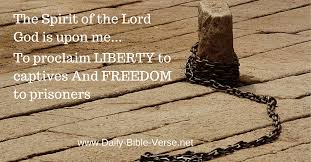
Jesus chose the reading himself, unrolling the scroll. He read Isaiah 61:1-2 replacing one phrase and leaving out much of the final verse. Maybe this was the version of the Aramaic Scriptures used in Galilee at the time; if not, then Jesus himself made the changes. Jesus omits those elements that might either spiritualize the text ("to heal the broken hearted") or threaten his audience ("to announce a day of vengeance"). He then sharpens the whole by inserting the phrase, "to let the oppressed go free." The reading therefore become clearly focused as good news for the poor and the oppressed.


The poor, the captives and the blind refer to the same oppressed group, the poorest of the poor who may be in prison due to debt. They were economically and socially oppressed. Prisoners were blinded because underground prisons were bereft of sunlight. The poor are placed at the centre of the gospel because they are the least, the lowliest, the lost.


Jesus announces a "Jubilee", a forgiveness of debt. The biblical Jubilee was held each 50 years when fields lay fallow, families returned to their ancestral homelands, debts were cancelled and slaves set free. The Jubilee restored a rough equality between families and clans. The inevitable increase in inequality and injustice over the years must be levelled down each half-century. The community could start afresh. Can you imagine if we did this today?!

Jesus slipped in the phrase "let the oppressed go free" from Isaiah 58:6. In Hebrew the oppressed are the downtrodden, those broken in pieces, the oppressed in spirit. India?

By quoting Isaiah, Jesus claims that he is both a messianic prophet of the sort that Samaria awaited, and a messianic king of the kind that Judea expected, one capable of setting in motion the wondrous events envisioned by Isaiah.


Jesus mandate encapsulates the gospel in miniature. This is what Jesus is about. This is what we should be about as Christians. Jesus’ mission is addressed to all nations. Jesus concern is a universal concern for the underprivileged and the outcast, a statement of commitment to social justice and reform, fostering mission to all in peace. 


The congregation reacts in a variety of ways: with enthusiasm, admiration, doubt, small-mindedness and, finally, with anger. The gospel brings conflict.


Who are the poor, the least, the lowliest, the lost? Is it us? Do we stand at their side?  Do we place the poor at the centre of the gospel, at the heart of our Christian community life and worship? 


These are the values we should be living by, our manifesto, not getting rich and fat and living off others labour, not rearranging churches but getting stuck in where the poor, the oppressed and the captives are. Then we shall truly be the church on earth. And we need to do it together. Anything else is just building our own empires.

What values does our life witness to? Are we really following Jesus? Amen


Song "I bind unto myself today".

https://youtu.be/zBnCjDcDMKo


When the star in the sky has gone

And the wise men have gone back to their homes

The real work of Christmas begins

To find the lost, heal the broken, feed the hungry and release the prisoner. 


Saturday, 20 January 2018

Epiphany 3 Mark 1v14-20


The Sea of Galilee is the setting of the first half of the gospel of Mark. A large freshwater lake about seven miles wide and 13 miles long, its shore is dotted with villages connected with the local fishing industry, the most prosperous part  of Galilee’s economy. The lake is also also called Sea of Genneseret or Lake Tiberius. It is about 209 meters below sea level, so it is the lowest freshwater lake on Earth. Due to this low-lying position, the sea is prone to sudden violent storms, as in the gospel stories.

One of the harbours was called  “processed fish-ville,” in Greek! .   Herod antipas  brought the fishing industry under regulation at Tiberias and built a royal palace, so there was work for itinerant carpenter/construction worker, to the Sea from Nazareth. the majority of fish were salt preserved or made into a fish sauce and shipped to distant markets throughout the empire. All fishing had become state-regulated for the benefit of the urban elite—either Greeks or Romans. They profited from the fishing industry in two ways. First, they controlled the sale of fishing leases, without which locals could not fish. 

These rights were normally awarded not to individuals, but to local kinship-based “cooperatives” (Gk koinōnoi)—such as the brothers Simon and Andrew or the Zebedee family in Mk 1:16-20.  Second, they taxed the fish product and its processing, and levied tolls on product transport.  Local administrators handled royal leases, contracts and taxes—such as “Levi son of Alphaeus,” in Mk 2:14. This had marginalized and impoverished fishing families. Leases, taxes and tolls were exorbitant, while the fish upon which local people depended as a dietary staple was extracted for export.  Thus fishermen were falling to the bottom of the economic hierarchy. They were looked down upon.The  later story about the rich man story writes of  “leaving” home, family and work. 
John was arrested and handed over to be imprisoned and face trial, and eventually be beheaded by Herod. As this happens Jesus takes over and begins his public ministry in Galilee his home province, which becomes the centre of his ministry. Jesus preached the “good news". This was normally news of Empire, of battles won and the word in Greek is appropriated for Jesus’s ministry, evangelism.       
John's task had been to prepare the Jews for Jesus's message. A hard task which led to his death. The kingdom is now open to all people in and through the ministry of Jesus the messiah.  Repent means change your direction. The word means turning around, turn to God and believe. 
So Mark introduces the story in three parts;

        i] The time has come / is fulfilled / completed. All that the prophets foretold concerning the coming of the messiah is coming to fruition in and through the person of Jesus.
        ii] The kingdom of God is near / at hand / bursting in upon us. 
       iii] Repent and believe.

Jesus was walking along the shore of Galilee. His ministry focusses on the Jewish towns around the lake, centered on Capernaum.

The fishermen he calls are fishermen and  labourers. Zebedee employed hired men, including his sons James and John. 

Jesus calls them to follow him. He is calling them as if for an apprenticeship in discipleship. And so they left their casting nets, packed up their fishing paraphernalia and followed him. Simon and Andrew, are called first. They were disciples of John the Baptist and were prepared for that call from Jesus. 

When Jesus had gone further on in in the boat he found James and John preparing their nets for the next day's fishing, mending, cleaning and folding. Immediately he called them, they came, these employees of Zebedee.

Who was the catalyst in your call or was it more gradual as for many? Ive known one woman who fled like Jonah, but that’s another story…


Saturday, 17 January 2015

Epiphany 3, Calling disciples, Mark 1:14-20


Our journey through Epiphany continues with John arrested, handed over to be imprisoned and face trial, and eventually be beheaded. As this happens Jesus as it were, is handed the baton. He takes over and begins his public ministry in Galilee his home province, which becomes the centre of his ministry.


Jesus preached the “good news". This was normally news of Empire, of battles won and the word in Greek is appropriated for Jesus’s ministry, evangelism.  John's task had been to prepare the Jews for Jesus's message. A hard task which led to his death. The prophecies have been fulfilled about this forerunner. The kingdom is now open to all people in and through the ministry of Jesus.  Repent means change your direction. The word carries the sense of turning around, turn to God and believe.  


So Mark introduces the story in three parts;


1. The time has come / is fulfilled / completed. All that the prophets foretold concerning the coming of the messiah, the anointed Davidic leader, is coming to fruition in and through the person of Jesus.
2. The kingdom of God is near / at hand / bursting in upon us. This is actualized in the person of Jesus, who inaugurates the kingdom in the present moment.
3. Repent and believe. The message demands a response. The call for repentance is similar to John's call. Turn to God. John and Jesus link repent and believe with forgiveness (with thanks to Bryan Finlayson).

Jesus was walking along the shore of Galilee, what we would call a lake rather than the sea. His ministry focuses on the Jewish towns around the lake, centered on Capernaum. The fishermen he calls are ordinary labourers. 
Zebedee employed hired men, including his sons James and John.

Jesus calls them to follow him. He is calling them for  an apprenticeship in discipleship. And so they left their casting nets, packed up their fishing paraphernalia and followed him. Simon and Andrew, are called first. They were disciples of John and were prepared for that call from Jesus.

When Jesus had gone further on in in the boat he found James and John preparing their nets for the next day's fishing, mending, cleaning and folding. Immediately he called them and they came, these employees of Zebedee.

How do we describe how we chose to follow Christ? For me it was when I was 17 and I went to a talk at a local comprehensive school. Dr Cicely Saunders was describing how at the age of 39 she had trained to be a doctor and then devoted her life to the medical care of the dying, setting up Britain’s first hospice. She was asked why she did it. And she simply said because of Jesus Christ and it was as if someone had turned a giant key in my heart. She was the catalyst to my call. Later I went to work at St Christopher’s Hospice in Crystal Palace and experienced the amazing presence of God in a palliative setting. My Christian journey began with this woman. I was privileged to meet her and to carry that message on.

Who was the catalyst in your call or was it more gradual as for many? Ive known one woman who fled like Jonah, but that’s another story…

THE HOUND OF HEAVEN
Francis Thompson


I fled Him, down the nights and down the days;
   I fled Him, down the arches of the years;
I fled Him, down the labyrinthine ways
   Of my own mind; and in the midst of tears
I hid from Him, and under running laughter.
             Up vistaed hopes I sped;
             And shot, precipitated,
Adown Titanic glooms of chasmed fears,
   From those strong Feet that followed, followed after.
             But with unhurrying chase,
             And unperturbèd pace,
     Deliberate speed, majestic instancy,
             They beat—and a Voice beat
             More instant than the Feet—
     'All things betray thee, who betrayest Me'.

Winter

Winter

Total Pageviews